
Inflation, Interest Rates, and Your Investments: What’s the Big Deal?
But what does it all really mean for you and your money?
FINANCE
Market Snooper
11/23/20253 min read
First Things First: What Exactly Are Inflation and Interest Rates?
Before we connect the dots, let's make sure we're on the same page. No complex jargon, I promise.
Inflation: When Your Money Buys Less
Imagine you could buy a coffee for $3 last year. This year, the exact same coffee costs $3.25. That's inflation in a nutshell. It's the rate at which the general level of prices for goods and services is rising, and subsequently, the purchasing power of your currency is falling.
A little bit of inflation is normal and even healthy for an economy. But when it gets too high, it becomes a problem. Your savings lose value, and your budget gets squeezed.
Interest Rates: The "Cost" of Money
Interest rates are the main tool that central banks, like the U.S. Federal Reserve (the Fed), use to control inflation.
Think of it as the "cost" of borrowing money.
When interest rates are low, borrowing is cheap. This encourages businesses to take out loans to grow and people to buy homes or cars. It stimulates the economy.
When interest rates are high, borrowing is expensive. This encourages saving over spending and helps to cool down an overheating economy.
So, how do these two forces influence your investments? This is where it gets interesting.
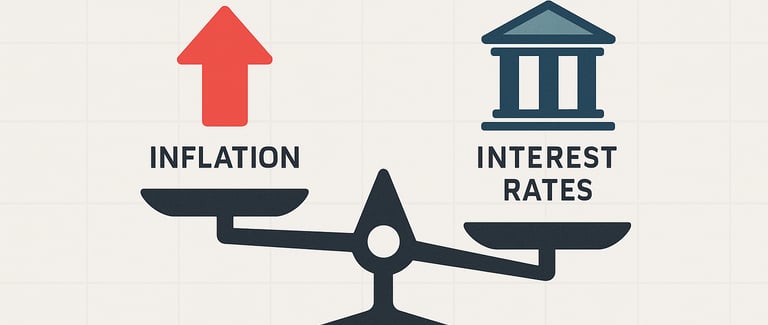
The Tug-of-War: How Interest Rates and Inflation Affect the Stock Market
The relationship between these three elements is like a delicate dance. When one moves, the others react.
The Scenario: High Inflation Hits the Scene
When inflation starts running too hot, central banks get concerned. Their primary job is to keep prices stable. To do this, they step in and raise interest rates.
This single action sends ripples across the entire financial market:
Borrowing Becomes Expensive for Companies: Businesses that rely on loans to expand, innovate, or even just operate suddenly face higher costs. This can squeeze their profits, making their stock look less attractive to investors.
"Safe" Investments Look Better: When interest rates are high, "safer" investments like government bonds or high-yield savings accounts suddenly offer a decent return. Why risk your money in the volatile stock market for a potential 7% return when you can get a guaranteed 5% from a bond? This pulls money out of stocks.
Future Profits Are Worth Less Today: This is a bit more technical, but it's crucial. Higher interest rates change how investors value a company. The future profits a company is expected to make are "discounted" more heavily, making the stock's present value lower. This particularly affects high-growth tech stocks whose value is based on big promises for the future.
Want to see this in action? A great first step is to track how major stock indexes, like the S&P 500, react right after a central bank announces its interest rate decision. You'll often see an immediate market response.
The Flip Side: When Interest Rates Are Expected to Fall
Now, what happens when the central bank succeeds in taming inflation? They get ready to cut interest rates to re-stimulate the economy.
This is usually music to the stock market's ears:
Borrowing Becomes Cheaper: Companies can once again borrow money affordably to invest in growth, which can lead to higher future profits.
Stocks Become More Attractive: As the returns on "safe" bonds and savings accounts fall, the potential for higher returns in the stock market looks much more appealing. Money flows back into stocks.
Future Growth Looks Brighter: Lower rates make investors more optimistic about the future, boosting company valuations.
So, What Should You Do About It?
Understanding this dynamic is the first step toward becoming a smarter investor. It’s not about timing the market perfectly—which is nearly impossible—but about making informed decisions.Stay Informed, Not Obsessed: Keep an eye on inflation reports and central bank announcements. You don't need to watch every tick of the market, but understanding the general economic direction is powerful. (That's what we're here for at CapitalFlowGrid!)
Think Long-Term: Market volatility driven by interest rate changes is normal. A well-diversified, long-term investment strategy is designed to weather these short-term storms.Look for Opportunities: Different sectors react differently. For example, financial companies (like banks) can sometimes benefit from higher interest rates. Understanding these nuances can reveal opportunities.The global economy is a giant, interconnected machine. By understanding its core components—like inflation and interest rates—you're no longer just a passenger. You're in the driver's seat.Ready to keep learning? Subscribe to our newsletter for weekly insights that break down the market's most important trends, delivered straight to your inbox.
Contact
Reach us for insights or support
© 2025. All rights reserved.